The Interviews
Jonathan Hill
When I was a child, my parents would take me and my sister to visit bookshops in Manhattan. We would go to Brentano’s on Fifth Avenue, and were allowed to buy as many paperbacks as we wanted. It was one of my favourite things to do, and it certainly gave me a taste for books and reading. From a young age, I made thematic collections, and kept my paperbacks in pristine condition. There wasn’t a single dog-eared copy on my shelves. The family home in New Jersey was full of old books. My father collected the history of Pacific voyages, and parcels arrived almost every day with his latest purchases. During the Second World War, he had served in the US Navy in the Pacific, where he developed a lifelong interest in the history of the places that he visited.
After I finished high school in the late 1960s, my father found me a summer job with John Howell Books in San Francisco. The shop was the centre of the rare book world of northern California, and Warren Howell was a prominent figure in San Francisco high society. Every weekday he wore a three-piece charcoal grey suit, and relaxed on Saturdays by wearing a tweed jacket, but always with a tie. His desk was at the back of the long, narrow shop so that he could see the front door. I was only paid thirty dollars a month, but I learnt so much just by watching Warren.
At the time Warren had three first-class assistants who taught me a lot about books and the business of bookselling. John Windle showed me different bookbinding styles, and would take examples off the shelves and teach me to recognise certain details. John had worked at Bernard Quaritch, and knew many of the great book collectors who were also Warren’s customers. Another assistant, Ron Randall, was a quieter version of John, but also very helpful to me. When they left in the mid-1970s to start their own business, Warren was so upset that he called them “Vandal & Swindle”. There was a third assistant named Michael Horowitz, the father of the actress Winona Ryder. He would show up at four in the afternoon and work until midnight, and was generally very different from everybody else. I think Warren put up with him because he was a great cataloguer. Horowitz later became the librarian of the Fitz Hugh Ludlow Memorial Library of psychoactive drug-related literature in San Francisco, and Timothy Leary’s archivist.
By the end of that summer, I knew that I wanted to become a rare bookseller. The idea of making a living by buying nice books and (hopefully) selling them for a profit was an attractive proposition. The following summer, by which time I was a student at the University of Pennsylvania, I found a job at Seven Gables Bookshop, working for Michael Papantonio and John Kohn, two of the greatest book dealers of New York City in the post-War period. Mike dealt in English literature and John was an expert in American literature. Although Mr Papantonio, as I always called him, was a man of few words, he was a great teacher. On one occasion he gave me some manuscripts to catalogue, although I had never handled such material before. ‘This is awful’, he said, ‘You’ve done everything wrong’, but then he taught me exactly what to do, and it was a wonderful experience.
John Kohn wasn’t in good health by the time I met him, and I was fortunate that he still spent a lot of time with me. The inventory of Seven Gables was so rich that John was able to show me half a dozen copies of the first American edition of Moby Dick and explain the bibliographical significance of the different colours of cloth bindings. The shop was a mecca for the cream of book collectors and librarians. H. Bradley Martin had lunch every week with Mr Papantonio. Although I wasn’t introduced to them, it was interesting to watch how those customers were treated.
While I was a student at Penn, I began to collect the works of William Carlos Williams, the American modernist poet, who had been a medical doctor in a town near my family home in New Jersey. Emily Mitchell Wallace’s bibliography of Williams had just been published. She was a professor at Penn, where I had the opportunity of meeting her. I also met Philip Roth when he was a visiting professor in Creative Writing. It was relatively early in his career, and he seemed delighted when I asked him to sign my copies of his novels.
A year before I graduated, I found a part-time job working for Clarence Wolf of George S. MacManus Company in Philadelphia. Clarence let me run his American literature department. It’s hard to imagine such a thing happening to a student today. Initially I was there for eighteen months, but I stayed on for another year after graduating in 1974. Incidentally that was the year in which my parents gave the Hill Collection of Pacific Voyages to the University of California at San Diego.
I was enjoying my work for Clarence, and developing contacts in the trade when Jake Zeitlin offered me a job in Los Angeles. Jake was always looking for an heir apparent, and I was not the first to occupy that position. He was a charming salesman, a born deal-maker and a wonderful person. He had sold encyclopaedias during the Depression, going from door to door with an enormous bag of books. When Bob Dylan walked into the shop, Jake had no idea who he was, but they had a long, philosophical discussion about Judaism – while the staff hid behind the bookcases to catch a glimpse of the famous man. In those days, there were plenty of book collectors in Hollywood, and Jake knew all of them. He was at the centre of Los Angeles cultural and intellectual life and was able to persuade organisations like the Ahmanson Foundation to buy books for UCLA.
It was Jake who introduced me to the history of science and medicine, which was one of his specialities. Robert Honeyman was one of Jake’s customers, and we would visit him at his home in San Juan Capistrano, where he had built a kind of bomb-proof bunker in the orange groves for his library of early scientific books. Inside the bunker Mr Honeyman smoked cigars and told anti-Semitic jokes to Jacob Israel Zeitlin, who would simply smile and then sell him a bunch of books.
After three years with Jake, it was obvious that being the heir apparent didn’t mean very much. I was twenty-six, and decided that the time had come to work for myself. I couldn’t afford to live in New York, and so I stayed in Los Angeles for my first year. I established my business on 1 May 1978, with about thirty books in my opening stock and little money. I knew I had to live by my wits and to run hard and scared. People talk about relying on instinct, but I spent hours studying institutional holdings, using NUC as my reference tool, and reading booksellers’ and auction catalogues, trying to figure out what was good and what was rare – and what I could actually afford to buy.
I decided to specialise in science and medicine, because I had learnt so much from Jake and it was a lively subject at that time. During my first year in business, Sotheby’s held the first of seven sales of the Honeyman collection, in which I bought many of the inexpensive lots. Decherd Turner, the director of the Bridwell Library in Dallas, bought a huge amount of books from me in my first year. When he saw that I was doing okay, he never bought another book!
I moved to New York as soon as I had made enough money to rent an apartment in Manhattan, an island where I live to this day. From the start I never wanted to have a shop. I’m not a good face-to-face salesman, and I prefer to do my business by sending out catalogues. A good cataloguer needs to be a story-teller. I’ve worked extremely hard to become one, and Steve Weissman of Ximenes Rare Books has always been my model.
During the 1980s I would go to Japan four times a year. It was boom time, and Toshiyuki Takamiya, the collector of early English literature, introduced me to Masatoshi Shibukawa of Keio University. Masatoshi had been to library school at the University of Hawaii, and spoke good English. We shared the same interests in science and medicine, and the history of book collecting. I would arrive in Japan with a heavy suitcase of books and Keio University bought everything. It was a marriage made in heaven.
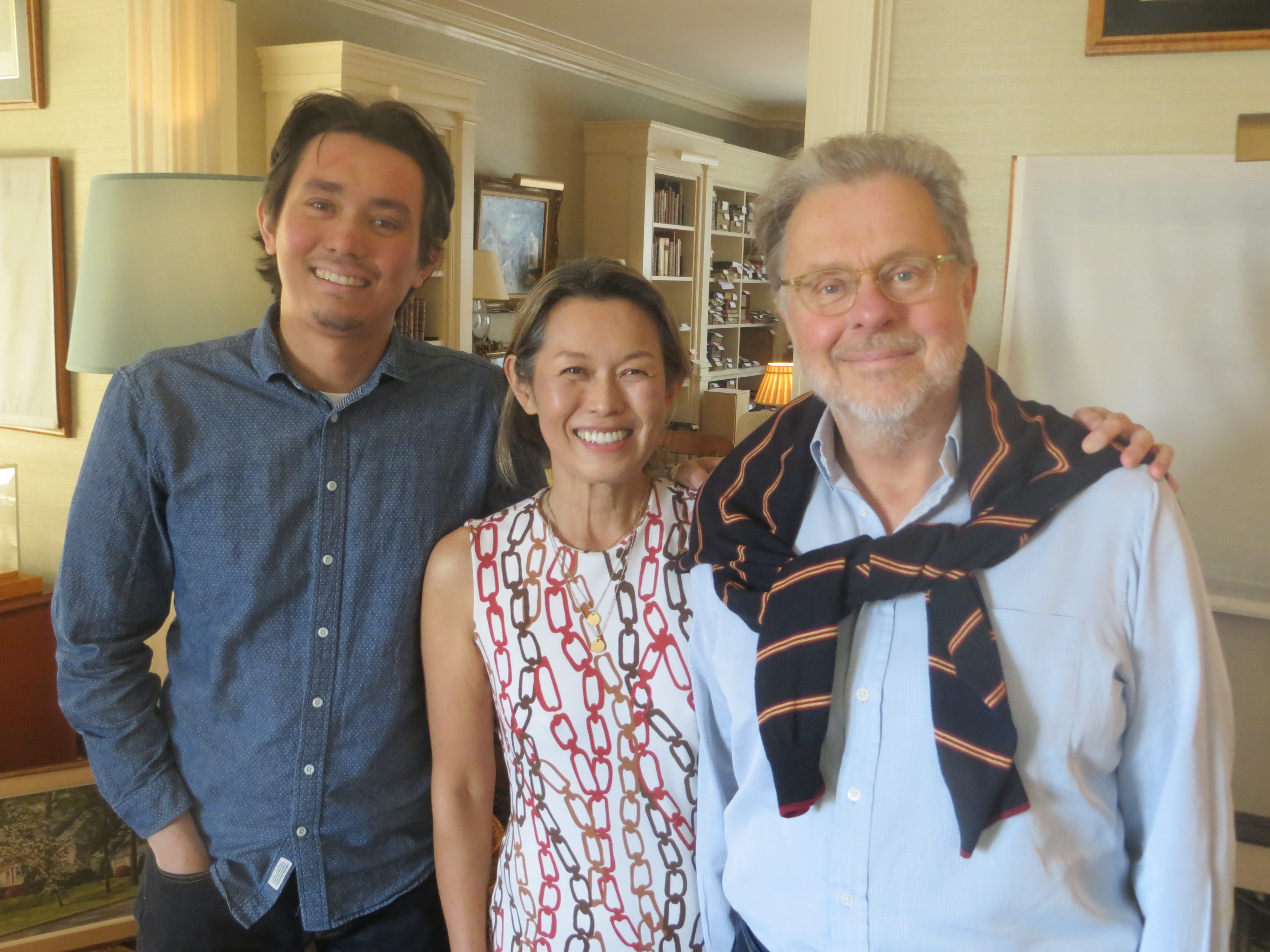
On one of my trips to Tokyo, I met my wife, Megumi. She was working in the international sales office of the fashion designer Yohji Yamamoto in their flagship store in Aoyama. I walked into the store, and the salesman went to fetch Megumi as she could speak English. It was love at first sight, and I bought two shirts and a pair of trousers which didn’t fit and I didn’t need. My trips to Japan became more frequent – in fact, you could say that Keio University paid for our courtship. We got married in 1990, just as the Japanese economic bubble burst, from which the market for Western antiquarian books never recovered.
Fifteen years later we decided to exhibit at a book fair in Japan for old times’ sake. We had brought Western books, and it soon became obvious that we wouldn’t sell anything. I decided to wander around the booths and found some nice Japanese medical books. They weren’t expensive and I bought a bunch of them. I didn’t know what I had bought, but I was able to relate to them because of the beautiful illustrations. I asked Megumi to do some research on them. She was already looking after the administrative side of the business, but this was the first time that she catalogued a book. We took them to a medical library, with which I had been doing business for many years. I also brought a bag of Western scientific books, and we sat down with the librarian, who was an old friend. ‘I’m not buying any of your books’, she said, ‘But I would like to buy all Megumi’s Japanese books’. It was dumb luck buying those books, but so much of my career is based on bumping into someone or something.
Both of our sons are interested in Japanese culture and Yoshi, the oldest, has joined us in the business. At first I didn’t know if I would make a good teacher, but Yoshi learnt quickly and – like his father – enjoys making money from bookselling. He made improvements to our website, which became a vital tool during the pandemic. People sat in front of their computers, and were able to buy books from our website in a simple and organised way. In fact our sales more than doubled during Covid. It was Yoshi who encouraged me to use the silhouette of a man sitting on a suitcase reading a book as our business logo. It’s a portrait of me as a younger man drawn by Nancy Stahl, who has designed stamps for the United States Postal Service and is our neighbour in New York.
Megumi will protest when I say that she has become the brains of the operation, but her knowledge of Japanese language and literature makes us almost unique amongst dealers in the West who specialise in Asian books. Although it’s been a great pleasure and adventure to learn about them with my family, I have no dynastic ambitions. One of our Japanese colleagues is the thirteenth generation in his family business, and I never forget that I’m a newcomer, and a barbarian too.
Interviewed for The Book Collector in Autumn 2025
Photo: Yoshi, Megumi and Jonathan Hill